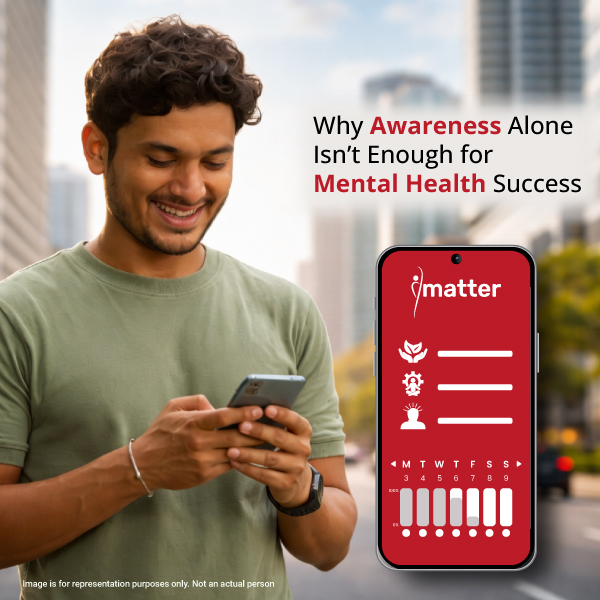
From Awareness to Action - How Digital Mental Health Platforms Turn Insight into Lasting Behavior Change
Rohan was never a sensitive person. He could describe his emotions in a surprisingly precise way - stress before deadlines, irritability during family calls, and a lingering anxiety that stayed with him late into the night.
Podcasts told him to breathe. Articles told him to journal. Apps asked him to track his mood. Yet every Monday felt like a reset. Rohan realized the problem wasn’t awareness - it was action.
Like many urban professionals, he had read books, taken assessments, and even tried therapy. He understood his triggers. He knew his patterns. But in real moments of stress, knowledge disappeared. The gap between knowing and doing remained wide.
The Awareness-Action Gap: Why Insight Doesn't Lead to Change
Traditional mental health systems often assume that insight leads to transformation. But psychology suggests otherwise. Behavior is shaped more by repetition, environment, and reinforcement than by intention.
We don’t change simply because we understand ourselves. We change when new behaviors become easier than old ones.
Rohan’s turning point came when he stopped treating mental health as a report and started treating it as a daily companion. Instead of being told what was wrong, he was guided on what to do - in the moment, not someday.
How Digital Mental Health Platforms Drive Lasting Behavior Change
Modern digital mental health platforms are no longer passive tools. They are active systems designed to drive behavior change.
Instead of overwhelming users with advice, they focus on micro-practices - small, actionable steps like a grounding exercise before a meeting, a reframing prompt after a conflict, or a reflective question at the end of the day.
These small actions, repeated consistently, begin to reshape emotional responses. Behavioral science shows that habits form through cues, repetition, and rewards - not through occasional insight.
As Rohan practiced these micro-actions, change became visible. He communicated better, paused before reacting, and recovered faster from emotional setbacks. Growth stopped being abstract and became real.
The Power of Micro-Practices & Consistency in Digital Mental Health
Consistency, not intensity, drives transformation.
Digital platforms succeed by integrating into daily life - nudging, adapting, and reinforcing behaviors over time. When Rohan missed a day, the system didn’t punish him. It adapted.
It recognized patterns like Sunday anxiety and midweek burnout, offering timely support. Change was no longer dependent on willpower but supported through intelligent systems.
This approach aligns with behavioral psychology and neuroscience: small, repeated actions are far more effective than rare breakthroughs.
ImatterAI: Bridging the Gap Between Insight & Action With AI-Powered Support
ImatterAI was designed to bridge this exact gap between awareness and action.
By combining psychometrics, behavioral science, and adaptive AI, it transforms emotional insight into personalized daily actions.
Instead of overwhelming users with information, it breaks change into small, manageable steps aligned with individual emotional patterns.
Through intelligent nudges, habit reinforcement, and continuous support between therapy sessions, ImatterAI helps users build lasting emotional resilience - turning intention into practice.
Everyday Moments When Insight Turns Into Action
Emotional growth often happens in small, everyday situations:
- Pausing for a grounding exercise before responding to a stressful message
- Recognizing a trigger and choosing a healthier reaction
- Reflecting after a difficult day instead of suppressing emotions
- Practicing better communication during tense conversations
- Returning to a habit even after missing a day
These moments show that real change doesn’t come from a single realization - it comes from repeated action.
When awareness meets consistent practice, transformation becomes inevitable.