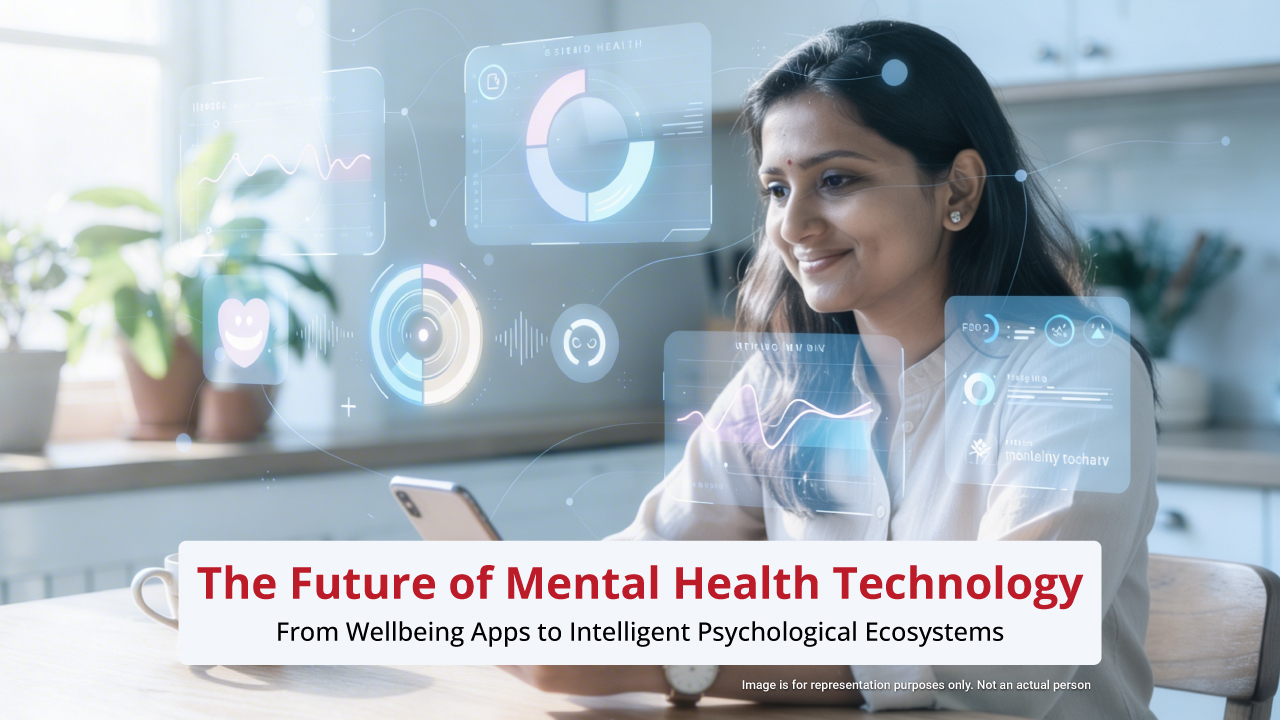
The Future of Mental Health Technology:
From Wellbeing Apps to Intelligent Psychological Ecosystems
It was a quiet Tuesday morning, and Vaishali was sitting at her kitchen table, gazing at her laptop. The e-mails were already coming in. Colleague messages, productivity tool alerts, and social media notifications formed an unceasing digital buzz. It was not even 9.30 a.m., but she was already feeling exhausted.
Vaishali is no different; she has installed several wellbeing apps over the years, like many other professionals across the globe. She had a meditation app that reminded her to breathe. A sleepwatch that examined her sleep habits, and an evening mood journal in which she was requested to rate how she felt.
But even with all these tools, something did not seem complete.
The Problem with Isolated Tools
Each app worked in isolation. One of them assisted her with meditation, another followed her sleep, and another provided some inspirational quotes. None of them, however, knew her as a person. None of them could relate the dots between her midnight scrolling, her anxiety before the presentation, and the emotional exhaustion that was manifested after a long week of working.
This is the silent weakness of most early mental health technologies. They were implemented as utility tools, rather than systems. Instead, they provided counsel, but not insight. Instead of focusing on the inner processes of human wellbeing, they focused on activities.
This is a change that is starting in the next chapter of mental health technology. Researchers, psychologists, and technologists around the globe are investigating how digital technologies can become intelligent psychological ecosystems - systems that nurture the mental wellbeing in a more holistic, gentle, and sustained manner.
Instead of requiring an individual to manually monitor all emotions, future systems can make friendly observations that are already evident in everyday life. Sleep alterations, communication patterns, or digital behavior can be early signs of stress or burnout. Technology could help determine when someone may need help, rather than just responding to a request.
Proactive Support: Early Intervention & Personalization
For someone like Vaishali, this may be an arrangement that comes to mind when her workload is rising, her sleep hours are shortening, and the little steps that can help prevent her from becoming too exhausted to continue. Breathing exercises for a few minutes before a meeting. A post-conflict reflection. An alarm to take a break before the day gets too full of obligations.
These systems will not drive out human therapists or counselors. Rather, they can be supportive companions who help individuals learn more about themselves between professional sessions.
It is not merely a technological shift; in fact, it is a philosophical shift. Mental health has always been a concern, addressed only at the point of crisis. However, a new psychological science is recognizing that wellbeing is not a single event but a process built daily through habits, relationships, work settings, and thought processes.
Technology can help raise awareness of such trends without imposing itself on them, as surveillance does. When designed responsibly, these systems can enable people to think, pause, and make better decisions in their lives.
Ethics & Privacy in Mental Health Technology
Nevertheless, the emergence of mental health technology is also associated with a range of ethical issues. Emotional information is very intimate. Mood patterns, stress patterns, and vulnerability needs need to be addressed with utmost privacy and concern. Mental health sites should also be transparent about how their data is used, who has access to it, and how individuals can control their personal mental health information.
The future mental health ecosystem will be based on trust!
The other critical issue is to maintain the human aspect. Technology can be a source of information and ideas, yet healing often occurs through empathy, compassion, and intimacy. Most responsible systems will thus integrate digital tools with human knowledge, so that technology supplements human relationships rather than substituting for them.
The point of this new terrain is not to have machines that can perfectly conceive emotions. It aims to create systems that help humans better understand themselves.
Embracing Complexity: No One-Size-Fits-All Solution
The mindfulness aspect of ImatterAI is delivered through a holistic model structured around four pillars: therapy, training, experiences, and technology. The platform does not see mental health as a single intervention but acknowledges continuous learning, guided reflections, and supportive environments as means of developing emotional wellbeing.
In its application, ImatterAI endeavors, through technology, to develop smart systems that help individuals cultivate greater self-awareness while upholding strict ethical standards in privacy-related and psychological safety matters. These tools do not replace human support; rather, they are your companions that help individuals identify patterns in their thoughts, behavior, and emotional states.
Simultaneously, ImatterAI combines therapy, training, and practical learning, meaning a person will be guided by an expert and learn practical skills to overcome the stresses of the modern world.
Mental health will not have a one-size-fits-all approach or solution, as digital life becomes ever more complex. Rather, it will arise with wise ecosystems that integrate human compassion, psychological science, and conscientious technology. In the future, the greatest invention will not necessarily be more intelligent algorithms, but the architecture of systems that consistently remind people that their wellbeing is important.